Traceability
Proof, not a promise
Every pot traces back, from terroir to comb.
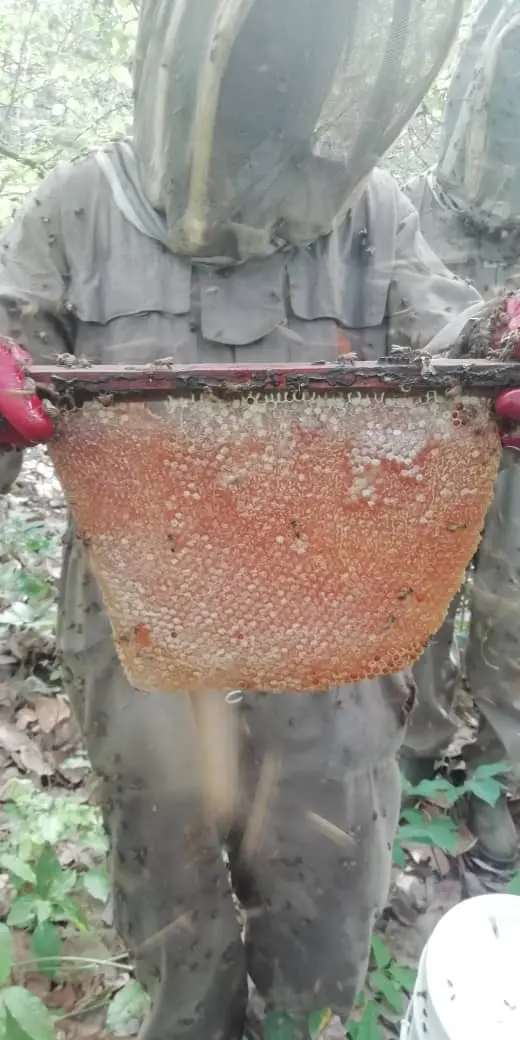
Two keys on every pot. The QR code leads to the page of the terroir it came from. The code printed under the pot identifies the lot: its community, its month of harvest, its year. Honeys produced under the health approval of the Togolese State (no. 00494/MRHART-CAB, national registration no. 191/23/MAEDR/CAB/SG/DE) and analysed by ITRA and INH. Its 2026 renewal is under way.
Decode your pot
Under your pot, a code like 3X05X25. Type it in: it tells you where your honey is from, who harvested it, and when.
The X's don't count: 305 25 or 3-05-25 work too.
The full table
| Code | Terroir | Community | Years |
|---|---|---|---|
| 0 | Aphro | Blend of terroirs | 2024 · 2025 · 2026 |
| 1 | Affem | Affem Bossou | 2024 · 2025 · 2026 |
| 2 | Affem | Cajou Espoir | 2024 · 2025 |
| 3 | Malfakassa-Fazao | Bowounda | 2024 · 2025 · 2026 |
| 4 | Malfakassa-Fazao | Kedi Kandjo | 2024 · 2025 · 2026 |
| 5 | Malfakassa-Fazao | Sada | 2025 |
| 6 | Danyi | Danyi Tonota | 2025 · 2026 |
| 7 | Danyi | Goyakopé | 2025 |
Our terroirs
Each area has its own flora, its own communities, its own signature on the palate.
More
What the code doesn't tell youthe limits
The code identifies a community and a harvest, not a precise apiary or a single hive. We can trace it back to the apiary in our records, but that detail isn't published here yet. If you'd like to know it for a particular pot, write to us with its code.
Why we don't sell monofloralthe house's stand
A honey called “monofloral” — acacia, lime, shea — claims that one flower dominates its make-up. That can be shown: by a pollen analysis, in a laboratory, cuvée by cuvée. Many claim it without ever having done it.
We won't. Not out of undue caution, but because it would be lying about what we know. We don't have that proof; so we won't write that word on our pots.
What we do have, and can show, is proof of a rich diversity. Togolese blooms are still largely intact: our bees forage a forest, a savannah, a plateau — not a field sown with a single species. That richness is exactly what gives each terroir its character. Claiming it is honest; claiming a single flower would not be.
It's also why we speak of a terroir and not a flower. A terroir we can name, place, and let you check.
Why a community, not a regionthe choice
A region harvests nothing: people do. Naming the community rather than the province says who did the work, and makes the trace verifiable against real people rather than an outline on a map.