
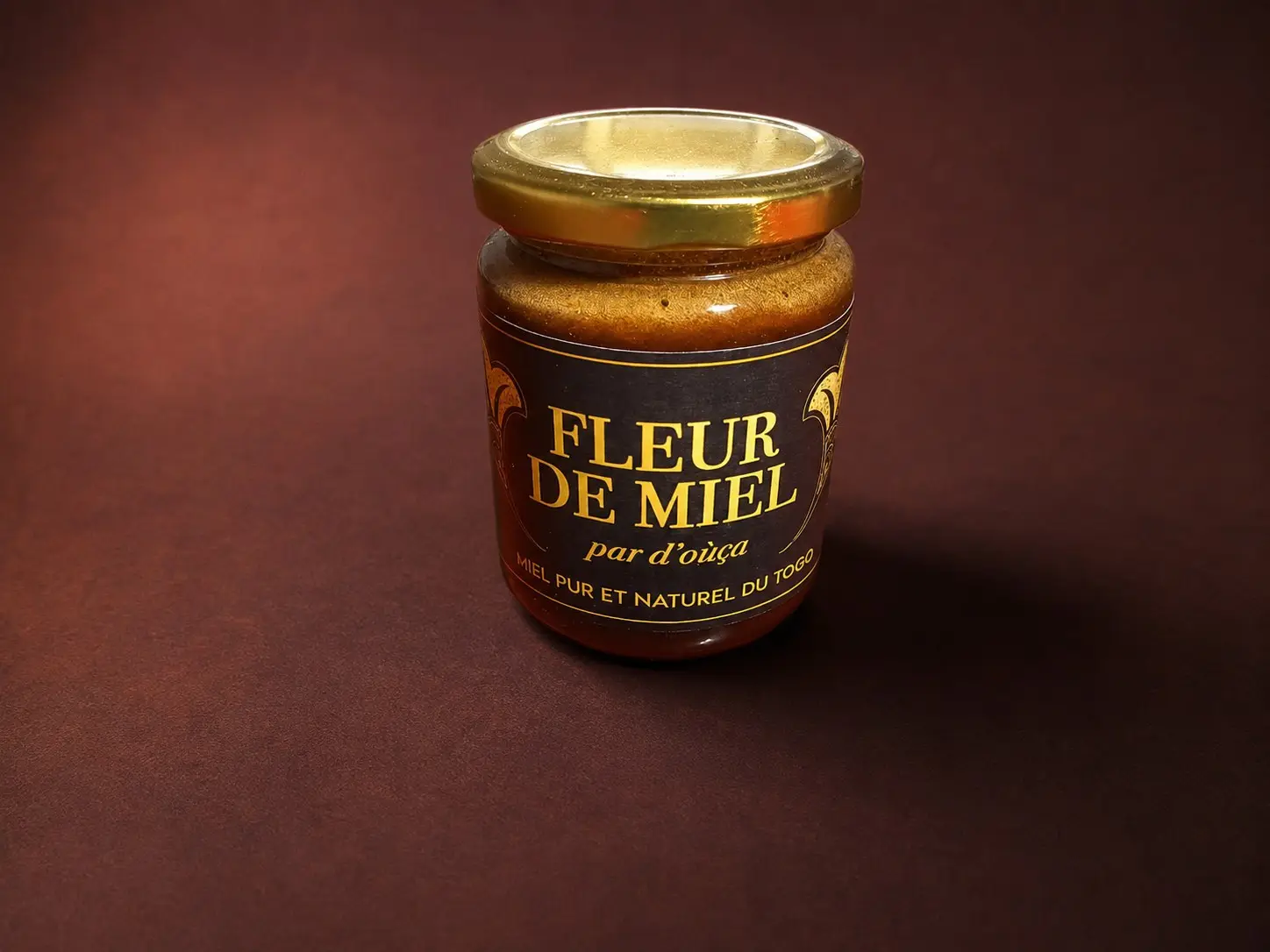
The blend of the cuvées
Fleur de miel
What the honey brings up.
A flower of honey that comes not from a single terroir, but tells a whole year's harvest in Togo.
A vintaged blend of the froth of four cuvées — Danyi, Affem, Malfakassa-Fazao and Aphro. An 80 g pot, limited run. Vintages 2024 and 2025 available; 2026 to come. Each pot carries its vintage and its blending lot number.
The matter
The lightest part of our honeys
The Fleur de miel is born during maturation. After cold extraction, our honeys rest in their settling tanks. The air trapped during pressing rises slowly and forms, at the surface, a fine froth of honey.
This fragile matter is lifted neither in haste nor indiscriminately. We wait until it reaches the texture we're after, then gather it by hand and keep it separately for each cuvée.
Scarce, changing, impossible to make to order: it carries the memory of the work done since the combs were harvested. We called it Fleur de miel.
The blend
Four cuvées, one vintage
Our cuvées usually tell of a precise place. The Fleur de miel tells of their meeting.
- Danyifloral and airy
- Affemround and generous
- Malfakassa-Fazaowoody and frank
- Aphrothe signature blend, candied fruit and spice
Each cuvée keeps its accent; together, they make a chorus. This blend isn't composed to find the same taste every year, but to reveal the face of one particular beekeeping season. The next vintage will necessarily differ.
The gesture
Five movements, from hive to pot
Extract without heat
The combs are pressed cold, with no fire or heating, to preserve the aromatic character of each harvest.
Let the honey rest
Each cuvée rests separately in its settling tank. Time lets the honey clarify naturally and its fine froth form.
Gather the Fleur
The layer formed at the surface is lifted gently. The cuvées aren't yet blended: each Fleur first keeps the identity of its origin.
Compose the vintage
At the workshop in Hédzranawoé, we blend the Fleurs of the different cuvées. The proportions are guided by the harvest available, the texture and the balance on the palate.
Pot in small batches
Packed in an 80 g pot, in limited quantity. Each pot carries its vintage and its blending lot number.
On tasting
Its profile
- Texture
- Crystalline, grainy and light.
- On the palate
- A sweetness less immediately sugary than a runny honey.
- Aromas
- Floral and fruity notes, crossed by wood, spice and a faintly toasted edge.
- Finish
- Soft, lasting, with a small spiced liveliness.
The Fleur de miel evolves in its pot: its texture may grow denser or more melting depending on temperature. That change is part of its nature.
Going further
What's left to know
How to taste it6 ways
First on its own, from a small spoon, to feel the texture. It can also go with:
- a fresh or aged cheese
- a slice of lightly toasted bread
- a plain yoghurt
- fruit
- a coffee or an infusion, added once cooled
- the ginger, turmeric or garlic preparations of our Roots movement
It also takes a simpler rule: open the pot and let yourself be surprised.
A naturally limited productionLimited run
The Fleur de miel is only a small part of each cuvée. We can neither speed up its formation nor decide in advance how much a harvest will give: its volume depends on the honeys received, their texture and how they behave during maturation.
Each vintage is therefore made in a limited run. When the pots are gone, we wait for the bees, the lands and time to begin their work again.
Its origin stays verifiable4 markings
The Fleur de miel is a blend, but it doesn't lose its trace. Each pot carries:
- its year of harvest;
- its blending lot number;
- the list of cuvées that make it up;
- a way back to the lands and communities of origin.
Danyi, Affem, Malfakassa-Fazao and Aphro are found behind the vintage, on the traceability page. A blend must not erase origins: it must make them speak to one another.
Frequently asked4 answers
What is honey froth?
The fine matter that forms naturally at the surface of honey during maturation: honey, and tiny air bubbles from extraction. We gather it and work it separately.
Do you add other ingredients?
No. Only our honeys. No aroma, no sugar, no outside ingredient.
Why blend several cuvées?
Because the Fleur de miel is rare, and each one expresses a different facet of the harvest. Blending them lets us tell not a single terroir, but a whole beekeeping season.
Is the grainy texture normal?
Yes. It's naturally crystalline and grainy: one of its singularities, not a flaw.

Harvested and packed in Togo